
Unemployment Rate In India
Naren Anchalia
Abstract
This paper is an analysis of why the unemployment rates in India are at a 45-year high. This paper explores the methods of calculating unemployment rate, the new metric of calculating the unemployment rate and discusses the differences between the new and the old metric. The paper also discusses the position of the government policies with respect to overcoming unemployment in India. There is an in-depth research on the unemployment and the policy reforms required for overcoming this situation. The paper does not have any political motives but an economic one.
Introduction
The Directive Principles of State Policy states that the state should direct its policy towards securing that every citizen, both men and women equally have the right to an adequate means of livelihood (Directive Principles of State Policy, 1950). But what do the recent
unemployment rate statistics reveal? The unemployment rate in India is at 6.1% with unemployment rate in rural areas being 3.8% among females and 5.8% among males and in urban areas it was 10.8% among females and 7.1% among males. (Periodic Labour Force Survey, 2017-18) which is a very high level and is a warning for the economy. But do these statistics reveal the exact values because there is a change in the metric and this cannot be compared to the previous years. There needs to be done an in-depth study on the economic values of the statistics and how it has been calculated.
Unemployment in India
Unemployment rate is the percentage of the population which is not working but is still seeking for an employment opportunity. People getting proper jobs are an essential part of an economy’s economic growth. But there is also an assumption that when the growth rate is higher in the capitalist segment the unemployment might increase (Patnaik, 2011). India’s unemployment statistics are shown here:
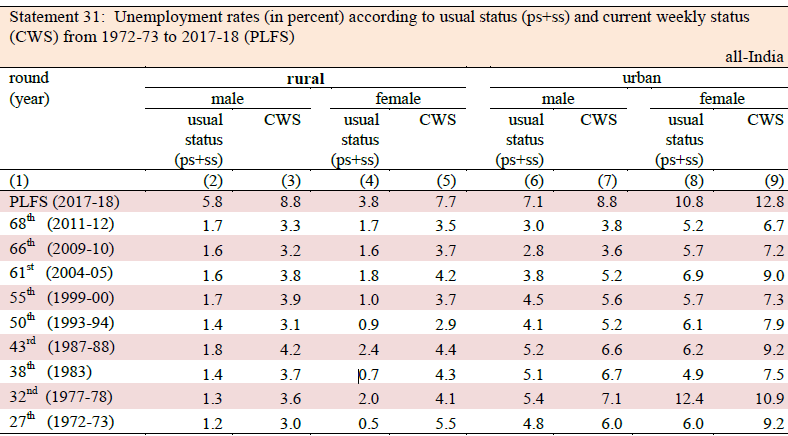
As the data shows that the unemployment rates have increased at a rapid rate over the years. In the case of rural males under the usual status the rate never crossed 2% but this time it is 5.8%. For the rural women it is at a high of 3.8%. The case is also same for the urban males and females where the unemployment is at ever high in the last 47 years.
But is it right to compare such a data at any cost? There is a change in the method of calculating unemployment and obviously it would not be correct to measure apples to oranges.
Calculation of Unemployment in India
India has been following majorly two ways to calculate the unemployment rate as suggested by the Dantwala Committee Report (1968). The first way is the usual activity status method (ps + ss) relates to the activity period of a person in the last 365 as reference period. That activity on which the person spent a larger time of the reference period is called the usual principal activity status. The second way is the current weekly activity status in which the reference period is the last 7 days preceding the day of survey. (Dantwala, 1968)
There are two more ways which include subsidiary usual activity status which that activity of the person is taken into account apart from his principal economic activity. The other is current daily activity status which is determined on the basis of a person’s daily activity status. (Dantwala, 1968)
The New Metric
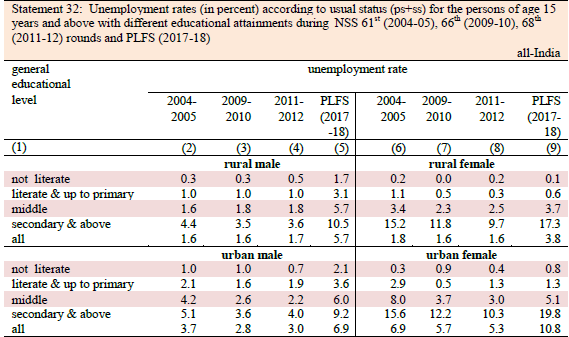
The metric change between the PLFS 2017-18 and the earlier Employment and Unemployment Situation Report is the reason behind the incomparability of the data sets. The new metric the unemployment rate have been calculated by giving more weightage to literate unemployed population. The earlier reports did not give much weightage to literate unemployed rather calculated it on a general basis. The unemployment rate among educated people in the rural and urban areas have increased since the last years as the data below suggests.
The Inflation and Unemployment Rate Trade-Off
The change in metric is not the only reason behind the high unemployment rate. There is a very important theory in Economics, i.e. Phillips Curve Theory which shows a negative relationship between the inflation and the unemployment rate. (Paul A.Samuelson, 1960). There is a short-run trade-off between unemployment rate and inflation. The government can either reduce inflation or reduce unemployment.
This reason can be used to define such a high unemployment rate in India. India’s inflation rate has reduced from 4.5% in 2016 to 3.6% in 2017 and to 3.4% in 2018 (World Economic Oulook, 2019). When we view this in reference to the Phillips Curve Theory it shows that there is no problem if the unemployment rate increases. The statistics suggest that the government has focussed more on a lower inflation rate instead of a lower unemployment rate. It can also be considered a good thing because unemployment affects only a small part of population but inflation affects the whole economy.
The Effects of Increasing Unemployment Rate
The unemployment rate is an important indicator of the economic growth of the economy. It suggests how much an economy is able to guarantee the people jobs for their livelihood. The negative causes of a high unemployment rate are not hidden to the economy. An increasing unemployment rate causes many people are out of the jobs and are not having enough money for consumption of goods. The aggregate demand for the goods decline and the producers now remove more people from jobs. The decrease in labour demand now leads to a decrease in aggregate supply which leads to a fall in the economy’s output. This leads to decrease in GDP growth rate and the economy becomes handicapped to provide its citizens a good standard of living.
The increasing unemployment also has one more important ill-effect. The employed people pay taxes. These taxes are then used by the government for welfare purposes. The increase in
unemployment decreases the amount of taxes received. A reduction in taxes means a reduction in revenue for the government which is cause for reduced government expenditure. This creates a loss for those people who survive on the government’s welfare schemes.
Government Welfare Schemes for Reducing Unemployment
- Mahatma Gandhi National Rural Employment Guarantee Act, 2005 (MGNREGA): This Act was passed by the parliament in the year 2005. Many changes have been made since then. This Act has been passed to ensure a minimum of 100 days per year employment to all rural people in India. It has been provided 25.92 crore people with employment and a total budget of Rs. 258.21 crores has been approved for MGNREGA for the year 2019-2020. A total number of 7.78 crore individuals and 5.27 households have worked in the year 2018-2019 under this Act. (Mahatma Gandhi National Rural Employment Guarantee Act, 2019)
- Pradhan Mantri Kaushal Vikas Yojana (PMKVY): A scheme by the Central Government under the Ministry of Skill Development and Entrepreneurship, PMKVY is a way through which many Indians can take up industrial skill training in centres formed by the government. The requirement of skilled labours in industrial sector can be fulfilled by such people who take up skill training. The PMKVY has 25507 training centres and has already trained 1949225 candidates and the placement performance is 54.14%. (Pradhan Mantri Kaushal Vikas Yojana, 2019)
- Pradhan Mantri Rozgar Protsahan Yojana (PMRPY): This scheme was designed by the Government of India in which the government will be contributing towards the total payment to be made by the employer for EPS and EPF from the 1st April 2018. There are two important benefits of this scheme where on one hand more people will find jobs and on other hand the employer will have an incentive to employ more people as it reduces the cost of hiring more labour. (Pradhan Mantri Rozgar Protsahan Yojana, 2019)
- National Food for Work Programme: This scheme was launched in the year 2014 in 150 most backward district of the country. Under this scheme labour provided was paid in kind by providing food to people for the day. This scheme was later put under the MGNREGA. (National Food for Work Programme, 2012)
Conclusion
The government has very good policies to curb unemployment. These policies need to be implemented properly to curb the unemployment among the educated. Thus, it needs to be taken into consideration by the government that every person gets benefitted by these policies and helps in the economic growth of India.
Conclusion
The government has very good policies to curb unemployment. These policies need to be implemented properly to curb the unemployment among the educated. Thus, it needs to be taken into consideration by the government that every person gets benefitted by these policies and helps in the economic growth of India.
References
- (1950). Directive Principles of State Policy. In Constitution of India (p. Art. 39(a)). New Delhi: Government of India.
- National Food for Work Programme. (2012, December 9). Retrieved July 6, 2019, from Indian Government Archive:
https://archive.india.gov.in/sectors/rural/index.php?id=14 - (2017-18). Periodic Labour Force Survey. Ministry of Statistics and Programme Implementation, National Statistical office. New Delhi: Government of India.
- Mahatma Gandhi National Rural Employment Guarantee Act. (2019, July 6). Retrieved July 6, 2019, from Ministry of Rural Development : http://mnregaweb4.nic.in/netnrega/all_lvl_details_dashboard_new.aspx
- Pradhan Mantri Kaushal Vikas Yojana. (2019, July 6). Retrieved July 6, 2019, from Ministry of Skill Development and Entrepreneurship: http://pmkvyofficial.org/Index.aspx
- Pradhan Mantri Rozgar Protsahan Yojana. (2019, April 12). Retrieved July 6, 2019, from Ministry of Labour & Employment: https://pmrpy.gov.in/
- (2019). World Economic Oulook. Washington D.C.: International Monetary Fund.
- Dantwala, M. (1968). Dantwala Committee Report. New Delhi: Planning Commission of India.
- Patnaik, P. (2011). Economic Growth and Employment. Economic and Political Weekly, 172-176.
- Paul A.Samuelson, R. M. (1960). Analytical Aspects of Anti-Inflation Policy. American Economic Association, 177-194
 Intellectual Economics